
Festivals and outdoor events
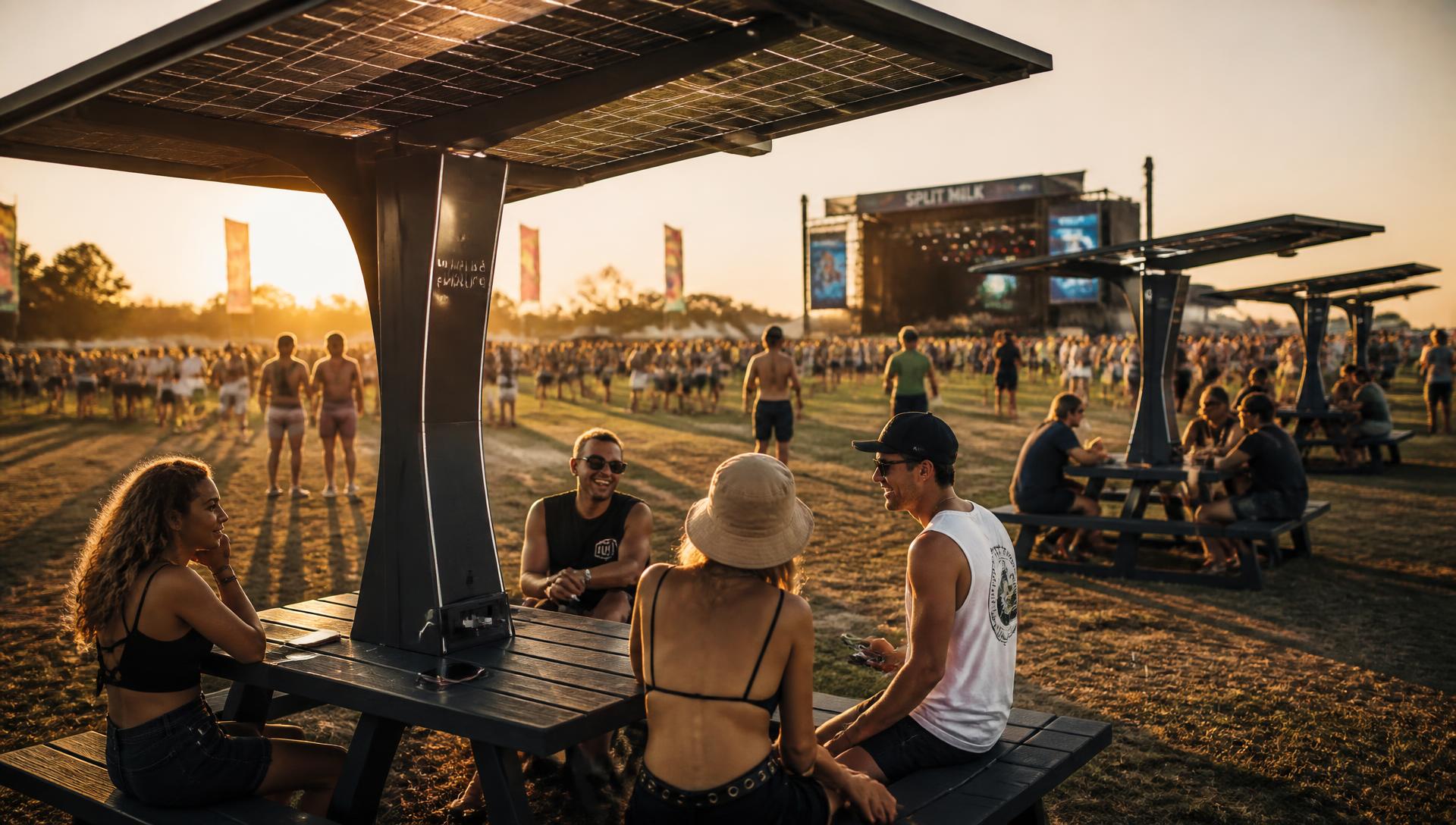
The only picnic table that charges a hundred phones a day and casts shade at noon
Festival sites are the purest expression of Canopei: no mains, brutal midday sun, tens of thousands of dead phones and a diesel set running all week just to charge them. Each unit arrives on a pallet, needs no groundworks, and leaves no trace.
Festivals mapped
Verified0
UK and European circuit currently tracked on this platform
Combined audience
Verified0
Published capacities across the mapped events
Unit demand across the season
Estimated0
Estimated: units per event sized on field count and audience density
Probability-weighted hire revenue
Estimated£0
Estimated: per-event hire price x units x win probability, single visit each
Fleet scenario builder
Pick a festival, holiday park, campus, attraction park, leisure or civic preset, then move any input; every figure below recomputes from the same model the one-pager prints
Attendance
210,000Event days
5 daysMean daily sun hours
6.2 hShare of the peak crowd to shade
4%Devices charged per unit per day
100Hire price per unit per event
£1,200Units deployed
240Units deployed
Assumed240
Assumed: set directly on the fleet slider
Energy generated across the event
Estimated3,413.5 kWh
Estimated: 620 W reclaimed array per unit x sun hours x 0.74 derate for soiling, heat and non-optimal tilt.
Phone charges delivered
Estimated120,000
Estimated: 18 Wh per 20-90% phone charge; capped by the energy actually generated that day. Capacity ceiling is 158 charges per unit per day at these sun hours.
Hard shade delivered
Estimated576.0 m²
Estimated: 2.4 m² hard shade per canopy at midday, 0.9 m² of shaded space per person. Shelters roughly 640 people at once.
Seats provided
Verified1,440
Verified: 6 seats per unit across the product family
Diesel displaced
Estimated1,297 L
Estimated: 0.38 litres of diesel per kWh delivered by a small generator set, 2.66 kg CO2e per litre (BEIS factor).
CO2e avoided
Estimated3,450 kg
Estimated: 0.38 litres of diesel per kWh delivered by a small generator set, 2.66 kg CO2e per litre (BEIS factor).
Hire revenue, this event
Estimated£288,000
Estimated: hire price per unit per event x units; fleet capital at GBP 1420 build cost per unit.
Cost to the event: £1.37 per attendee · fleet capital £340,800 · pays back in 1.2 events of this size
Why a festival buys this, in four sentences
The pitch, stripped
158 phone charges per unit per day
Estimated: 18 Wh per 20-90% phone charge; capped by the energy actually generated that day. Charging tents are the longest queue on site and the least loved.
2.4 m² of hard shade per unit
Festivals run in the hottest weeks of the year. The canopy is the shade structure and the generator at the same time, so shade stops being a cost line.
Removes a charging-tent generator run
Estimated: distributed solar seating displaces the small generator sets used purely for device charging, which sit at the top of most festival carbon reports.
Movable, off-grid, no groundworks
Because reclaimed panels sit on furniture rather than a roof, the MCS reuse barrier never applies and the whole unit is craned in and out on a forklift.
Season fleet model
One fleet, hired repeatedly across the calendar
Events per unit per season
4
Fleet size required
Estimated0
Estimated: total unit demand divided by re-hires per unit across the season
Season hire revenue
Estimated£0
Estimated: hire price per event x units x events per unit
Revenue per unit per season
Estimated£0
Estimated: a hire unit earns back a large share of build cost each summer
Off-season redeployment
AssumedCouncils, parks, campuses
Assumed: the same fleet is placed on public realm and campus sites September to April
The festival calendar clusters into fourteen weeks. A unit that travels between events earns several times a single sale price over its life, and the same movable asset then covers autumn and winter placements. This is why hire, not sale, is the festival route.

Second-life supply
Panels stripped from UK roofs cannot be re-certified for roof reuse under MCS, so they arrive cheap. On a movable unit they are simply a canopy that generates.
UK circuit
Ranked by probability of a first hire
No records
European circuit
Phase two, alongside the EU manufacturing ladder
No records
Glastonbury, specifically
The reference case
A single field, measured, then the whole site
Glastonbury spans roughly 900 acres with almost no built shade, an audience of around 210,000 and a published commitment to cut generator use. We propose one field: sixty units, metered, with charging sessions and canopy dwell time logged across five days. The output is not a brochure but a dataset the festival can put in its own sustainability report, and the same dataset closes Reading, Leeds, Latitude and Wireless through one promoter.
- 1
Field trial
60 units in one field, metered charging and dwell time
Year 1, June
- 2
Published dataset
Charging sessions, Wh delivered, generator hours avoided
Within 30 days
- 3
Promoter portfolio
Festival Republic events negotiated as one season deal
Year 1, autumn
- 4
EU circuit
Tomorrowland, Sziget, Mad Cool: highest heat, highest need
Year 2-3
Per-event arithmetic
Units proposed
Estimated60
Estimated: one field at festival seating density
Phone charges available per day
Estimated9,480
Estimated: 158 charges per unit per day at 6.2 sun hours x 60 units
Hire value, one event
Estimated£72,000
Estimated: £1,200 per unit per event hire rate
Festival demand is the reason the addressable market is not a £400k idea. See the addressable market and pipeline for the full bottom-up sizing.