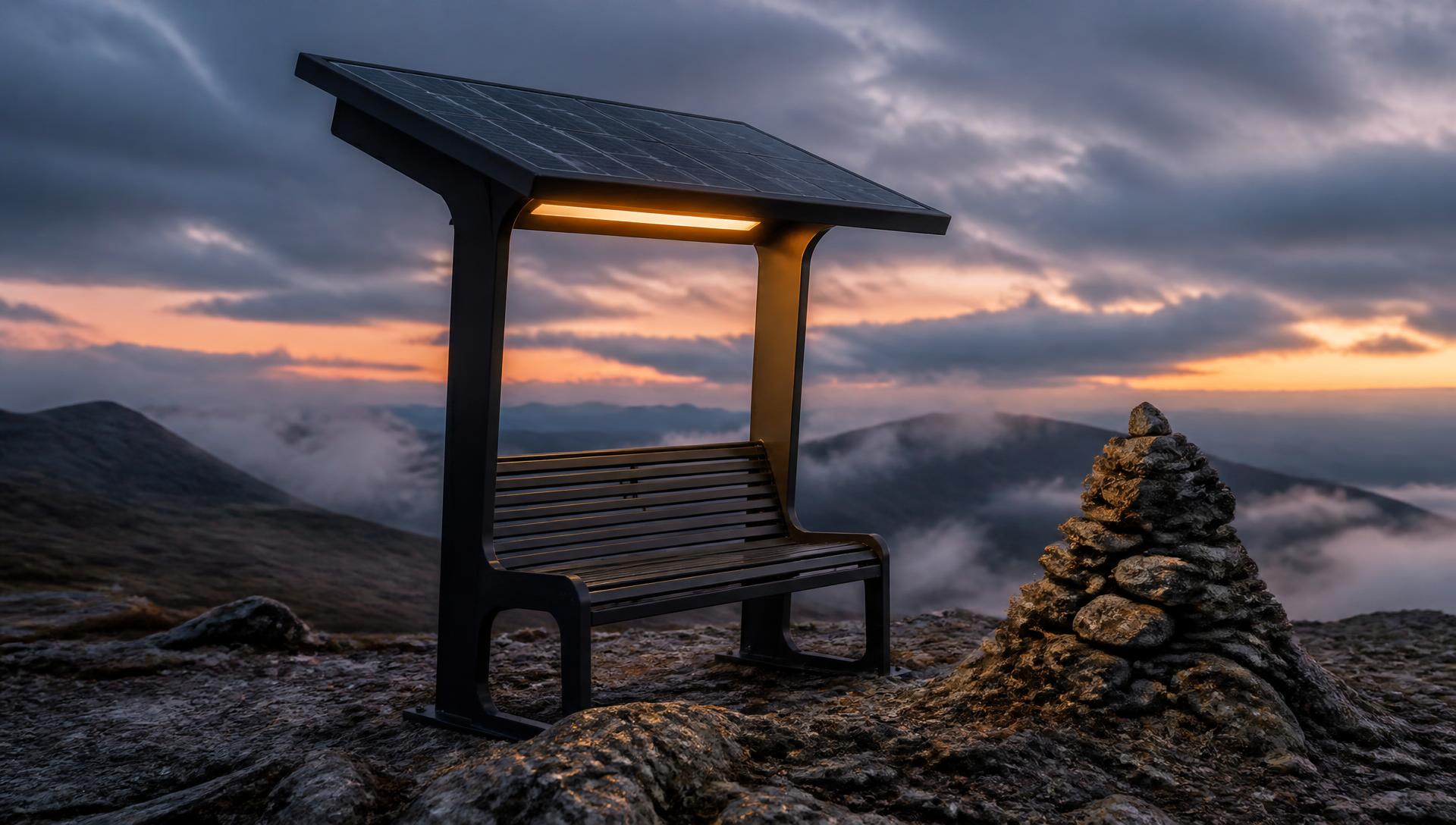
No cable, no trench, no electrician. So it can stand on a mountain.
Every charge a Canopei bench gives away is free, because there is nothing to bill: no supply connection, no meter, no card reader. That same fact is what lets a bench exist where no cable will ever reach. Put one at a summit, a trailhead or halfway along a long trail and it stops being furniture and becomes a safety point: a lit marker you can find in poor visibility, a socket for a head torch, GPS unit, satellite messenger or radio, and a mesh node carrying a message out where there is no cell signal.
£0
Cost to the person charging, forever, because there is nothing metered
Verified11,776
Modelled phone charges given away by one flagship bench in a year
Estimated24/7
Radio and marker light hold priority over public charging
AssumedMarker light draw
Estimated0.6 W
Dusk to dawn at a remote waypoint
Mesh rnode draw
Estimated1.4 W
Always on, off-grid message path
Head torch refills per kWh
Estimated111
9 Wh per 18650 torch pack
Groundworks required
VerifiedNone
Ballast or reversible screw piles
The energy is already captured. Charging people is the only sensible thing to do with it.
A metered charging point has to earn back a supply connection, a meter, a payment rail and a standing charge, which is why almost every public charger has a card reader on it. A Canopei canopy has none of those costs, so the marginal cost of a delivered charge is zero. The site owner buys the furniture once and the charging is simply what the furniture does, like the seat and the shade. No app, no account, no tariff.
No records
Midwinter figures deliberately, not summer ones. The same flagship canopy supports several times these counts between April and September; the winter number is the one a buyer should plan around.
EstimatedDecember at 57 degrees north is the test that matters
Anyone can model a solar bench in June. Set the month to December and the latitude to northern Scotland and generation falls to a small fraction of the summer figure. The design answer is not to pretend otherwise, it is to rank the loads. The mesh radio and the marker light are protected, a reserve is held back so the bench never goes dark, and public charging is the load that flexes. On the worst days the bench is still a beacon and still a node, it just stops being a charging point until the sun returns.
Month
DecLatitude, degrees north
57°NCanopy array rating
405 WUsable battery
1,280 WhShading and horizon loss
12%Reserve held back for safety loads
45%Generation, mean Dec day
Estimated105 Wh
0.36 peak sun hours
Safety loads
Estimated44 Wh
Radio 34 Wh, light 10 Wh over 17.1 dark hours
Left for public charging
Estimated52 Wh
3 phone charges, 5 head torch refills
Reserve autonomy
Estimated13.1 days
Radio plus light on stored energy alone, zero sun
Generation across the year at this site
Grey months are the ones where the model sheds public charging to protect the marker light and the radio. At this site that is 0 of twelve months, and the bench still gives away about 188.4 kWh a year, roughly 11,776 phone charges or 5,092 power bank fills.
Getting it up there, and holding it down once it is
Remote placement is a logistics and consents problem, not an electrical one. Units go up flat-packed and carried, by quad or packhorse, or on a shared sortie with the helicopter flights that already service upland path repair. Nothing is concreted: ballast trays on stone and hardstanding, reversible screw piles on soft ground, so a unit can be lifted out and the ground left as found. Wind loading sets the canopy area, and the same movability that makes consents easier lets a coastal unit be pulled back for storm season.
Three failures on a hill, and what a charged device prevents
Benighted without light
A flat head torch turns a straightforward descent into a callout. A waypoint that refills a 9 Wh torch pack in under an hour of the surplus it already has costs nothing per use.
EstimatedNavigation dies mid-route
Cold kills phone and GPS batteries faster than anyone plans for. A charge point at the junction where people go wrong keeps the map and the location share alive for the rest of the day.
EstimatedNo signal to call for help
Each unit is an rnode on the EN/ABEL Communications Enigma Mesh, so a short message can hop out through the mesh in places with no cell coverage at all, and rescue teams can charge radios at a forward point without running a generator.
Assumed