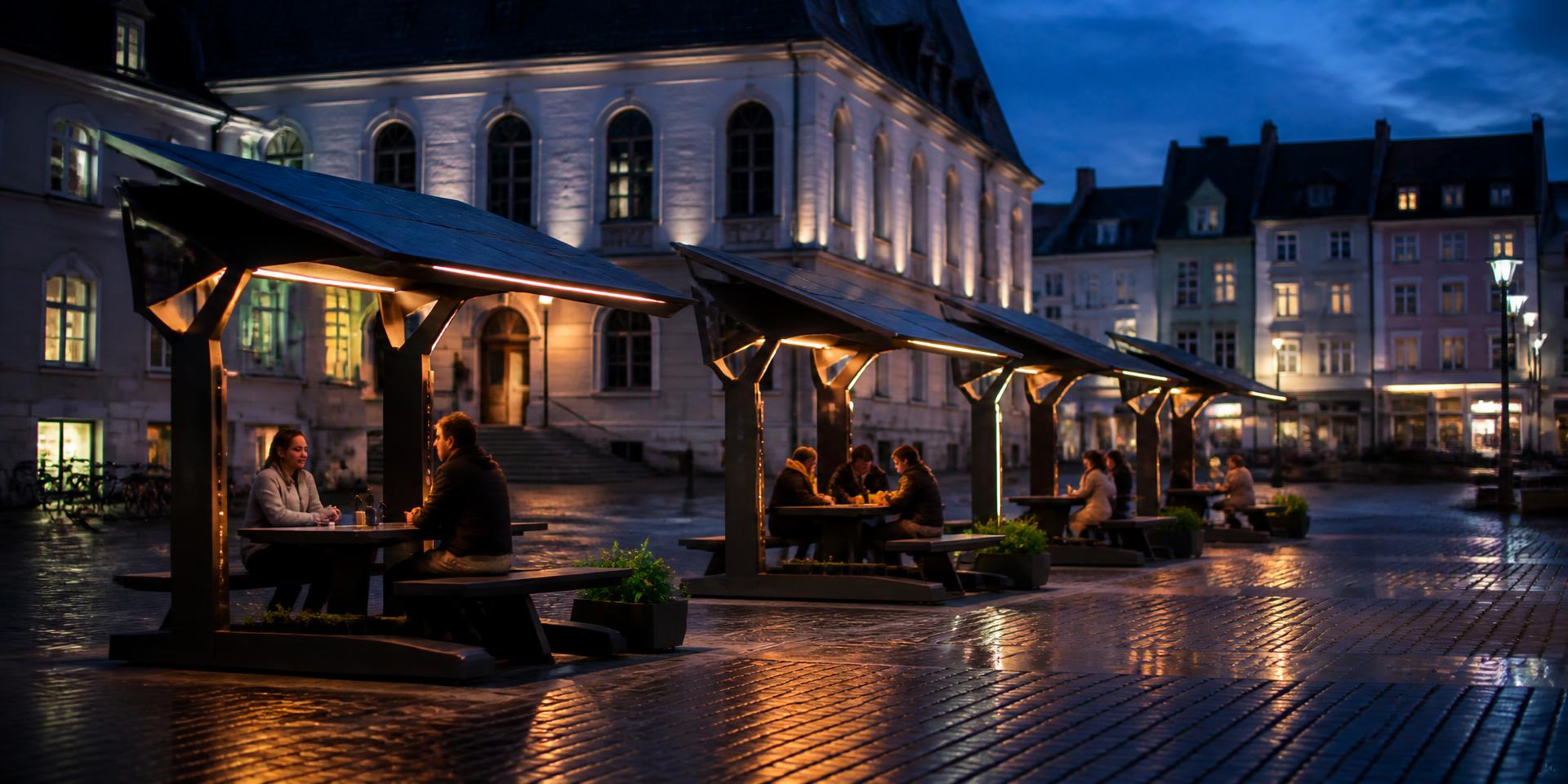
Someone already patented a solar canopy table. Here is exactly how we sit against it.
A buyer asking whether we are clear to sell deserves a claim chart, not reassurance. This is our own element-by-element read of GB2542927, solar canopy table arrangement, and registered designs in the same class, held by The Solar Range, United Kingdom, checked 23 August 2026. Five of seven elements we sit outside because of decisions taken for structural, sealing and repair reasons before the patent was ever read. Two are arguable, and both are designed around rather than argued.
5
Elements we sit outside
Verified2
Arguable, design-around held
Verified£0
Tooling change if we drop the table option
CommittedWhere the position sits today.
Current standing
Desk read-across complete and design-arounds identified. Written attorney opinion instructed against the claim chart below, to be held on file before any UK canopy table quotation is issued.
What this is not
This is our own technical reading, not legal advice. Where a claim element is arguable we have designed around it rather than argue it.
Seven elements, our configuration against each one.
The pattern worth noticing: the seating-first format, end-carried canopy, vertical socket faces and seat-void pack were all chosen for uplift, ingress and repair reasons. Clearance is a by-product of good engineering rather than a legal manoeuvre.
- Our configuration
- Seating-first format. The canopy spans a bench run and the table leaf is an optional accessible-variant addition, not the supported element.
- Our read
- Arguable, designed around
- Design-around held
- The canopy is structurally carried by the bench spine, not by a table pedestal, and the standard product ships with no table at all.
- Our configuration
- Twin offset legs at the ends of the bench run, no central column, and nothing passes through a seating or table surface.
- Our read
- Outside the claim
- Design-around held
- Structural route is already end-carried for the wind uplift case, so this costs nothing to hold.
- Our configuration
- Outputs are in sealed vertical faces at each end of the bench at 820 mm, set by the accessible reach range, never in a horizontal surface.
- Our read
- Outside the claim
- Design-around held
- Vertical faces were chosen for IP66 and standing-water reasons before the patent was read.
- Our configuration
- Pack housed in the seat void under the deck, on a slide-out tray.
- Our read
- Outside the claim
- Design-around held
- Seat void placement is required for the plank-level repair rule and thermal behaviour.
- Our configuration
- No wireless charging. USB-C power delivery only, on efficiency and vandalism grounds.
- Our read
- Outside the claim
- Design-around held
- Deliberate omission. Wireless pads lose 30 to 40 percent and cannot be sealed as reliably.
- Our configuration
- EN/ABEL mesh node on 868 MHz carrying a control plane, operated by a third party, not a public Wi-Fi access point.
- Our read
- Arguable, designed around
- Design-around held
- Node is supplied and owned under the operator agreement, so the furniture is a mount rather than a networked product.
- Our configuration
- Graded second-life modules of mixed nameplate, each string balanced electronically rather than by matched hardware.
- Our read
- Outside the claim
- Design-around held
- Mixed-grade string management is our own capability and is the harder thing to copy.
What we protect, what we publish, and why the two differ.
We file on the genuinely novel part, mixed-nameplate second-life string balancing, and deliberately publish the load priority rules instead of owning them. A published shed order becomes a standard other suppliers get measured against, which is worth more than a monopoly on it.
Reclaimed module mounting frame with mixed-nameplate string balancing
UK priority filing prepared, to be filed before the first public demonstration of the production frame
This is the genuinely novel part: accepting modules of differing output into one canopy without matched hardware.
Plank-level replaceable deck on a hemp-plastic composite section
Registered design filing for the plank profile and its fixing detail
Cheap to hold, hard to imitate closely without copying the profile, and it protects the repair promise.
Load priority controller with published shed order
Kept as know-how and published as policy rather than filed
Publishing it is worth more than owning it. It becomes a standard others are measured against.
Canopei Fleet telemetry frame and mesh contract
Copyright and trade secret, with the contract published so buyers can audit it
Software protection here is practical, not patent-shaped.
If the opinion comes back badly.
- ·Every element we mark arguable already has a design-around costed at under 40 GBP per bench and no tooling change.
- ·The canopy support route, the output face position and the pack location are all outside the claim set on the current design, so a bad opinion narrows the table option, not the product.
- ·Table leaves would be dropped from the UK offer and retained for export markets while a licence discussion runs.
- ·No UK canopy-table quotation is issued until the written opinion is on file. That is a hard gate, not a preference.
Where this sits
This closes the patent clearance row on the differentiation roadmap, and the patent holder is profiled on the competitor watch.