
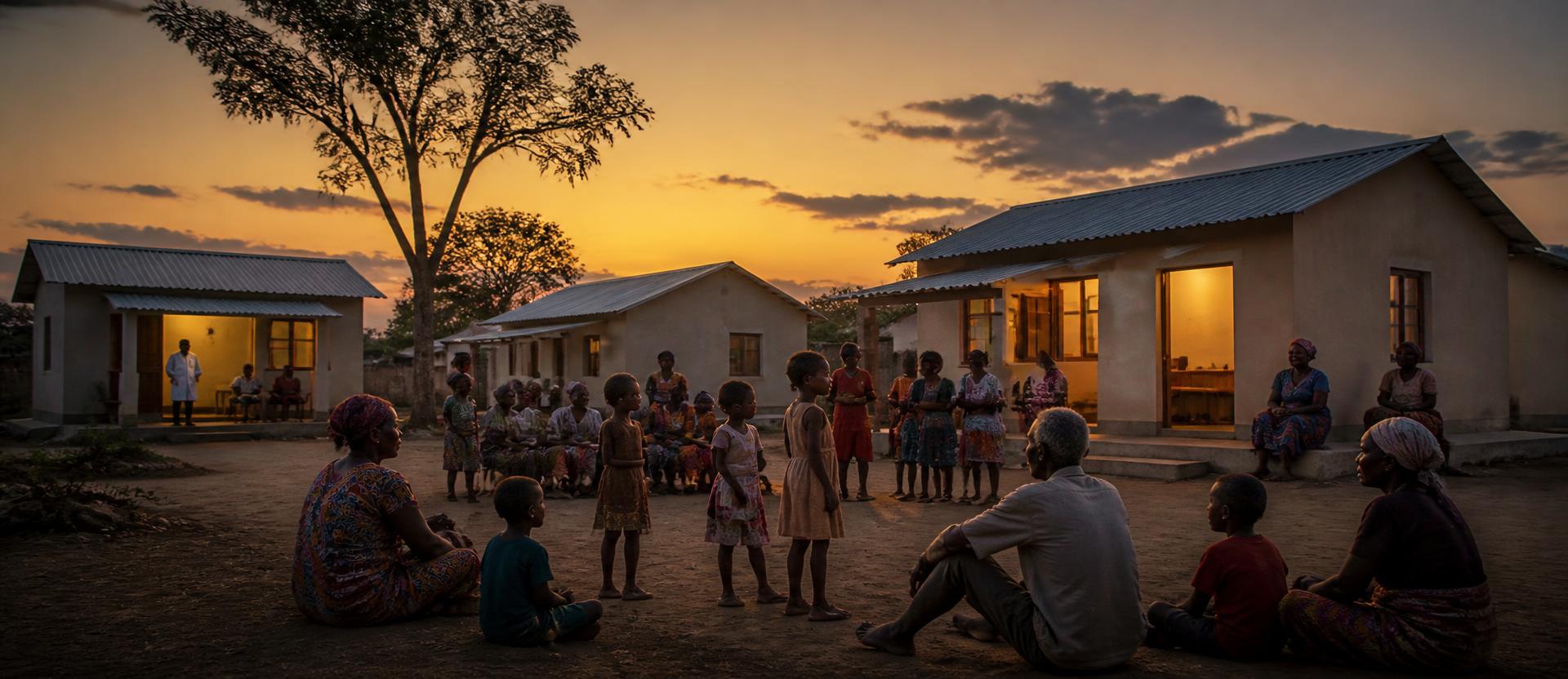
Four sold here. One given where there is neither power nor signal.
The rule is simple enough to hold us to: for every four benches sold in the United Kingdom, one is provided to a community that has no dependable way to charge a phone and no dependable way to be reached. It is funded from the tenth of profit we already pledge back, so UK pricing is unaffected, and the regions follow the grower network, so the places that supply the hemp residue in the deck are the places that receive benches. Each donated unit is also an environment node, measuring sound level and rainfall where almost nothing is measured today. Nothing on this page is a signed programme, and each region says which it is.
1 in 4
UK units to donated units
Committed£3,505
All-in cost of a donated bench
Estimated10%
Of profit pledged, funding the programme
CommittedA socket that costs nothing, a radio that needs no operator, and a sensor where nothing is measured.
In much of the network, charging a phone is a paid service sold from a generator, the coverage map runs out between market towns, and the nearest rain gauge is a district away. A donated bench answers all three, in this order.
Free charging, with no meter
In much of the network's supplying regions, charging a phone is a paid service sold from a generator. A bench removes that cost permanently and needs no fuel to do it.
A LoRa mesh node where no operator reaches
This is the case that matters most. Where there is no cellular network at all, the mesh radio still carries short messages between benches and onward to any node that has a link, with store and forward across the gap.
A public hotspot where a local network does exist
The public lane joins whatever local network is strongest and serves up to ten devices, on the same multi-network switching logic the UK fleet uses.
An environment node on the same power and the same backhaul
Sound level, rainfall, temperature, particulates and light, measured quarter-hourly at a fixed point that already has generation and two data lanes. In regions with almost no ground weather stations, this is the part local agencies ask about first.
Shade and a place to sit
The canopy is the reason the array is large enough to matter. In hot climates the shade is not a secondary benefit.
Same hardware, same lanes
A donated unit is not a stripped variant. It carries the same two separate cellular lanes, one for the public hotspot and one for the mesh control plane, and the same LoRa rnode, described in full on EN/ABEL Communications. Where a country requires a licence for the mesh band, the radio ships disabled until that licence is held.
Choose a region, then move the two numbers that decide whether the pledge covers the rule.
The rule generates units from UK sales. The pledge pot funds them from profit. Region changes almost everything else: freight, irradiance, how many people pass, what a charge currently costs and how much of the siting area has no signal at all. Every output below is Estimated.
Region
High irradiance and open terrain give the best charge and mesh numbers on the list. Coverage is patchy rather than absent, so both lanes earn their place.
Offer madeCost basis per donated unit, East and Southern Africa
- GBP
- £2,117
- GBP
- £620
- GBP
- £480
- GBP
- £288
- GBP
- £214
- GBP
- £3,719
Beneficiaries
100
Benches the rule commits
Committed25
Benches the pledge funds this period
Estimated4,125
People within walking distance
Estimated£21
Cost per person reached
EstimatedEnergy outcomes
224,250
Device charges per year
Estimated2,691 kWh
Energy delivered per year
Estimated£40,365
Household charging spend removed per year
Estimated12.0 t CO₂e
Generator emissions avoided per year
EstimatedConnectivity uplift
1,810 km²
Mesh coverage created
Estimated1,856
People brought inside a data path who had none
Estimated250
Concurrent public hotspot seats
Estimated4.8 km
Effective mesh radius in this terrain
EstimatedEnvironment nodes
25
Environment nodes created
Estimated4,968,000
Published readings per year
Estimated828,000
Noise aggregates published per year
Estimated828,000
Rainfall aggregates published per year
Estimated24
Continuous noise monitor-years created
Estimated1.4
New rain gauges per 100 km² of siting area
EstimatedNoise and rainfall, why they lead
Sound is reported as LAeq 15 min, LA90 background, LAmax at 96 aggregates a day, and rainfall as mm per 15 min, mm per hour, daily total, rain-onset flag from a tipping bucket in the canopy drip line, 0.2 mm per tip. Both are recorded, never raw audio: the microphone publishes decibel statistics only, as set out in the privacy boundary below. Sub-Saharan Africa has roughly 0.4 ground weather stations per million people against about 9 in Europe, which is why a fixed point that already has power and two data lanes is the part local agencies ask about first. Every figure here is Estimated from stated reporting rates and the 345 usable service days assumed for this region, not from a deployed fleet.
Reading
The pledge funds 25 of 100 units at this profit level. The remaining 75 carry over rather than being quietly dropped, because the commitment is one in four sold, not one in four we can afford this year.
Programme cost £350,500 against a pledge pot of £90,000, which is 389 per cent of the pot.
It already has power, a fixed position and two data lanes. A monitoring station is the cheapest thing left to add.
An environmental sensor normally costs a site survey, a power connection and a backhaul contract before it costs a sensor. On a bench all three are sunk. The head is £214 of parts, 25 minutes to retrofit, and draws 120 mW, which is 4 per cent of a December day's generation. Sound level and rainfall lead, because they are the two readings most often asked for and least often held.
- Reports
- LAeq 15 min, LA90 background, LAmax, dB(A)
- Accuracy
- Class 2 equivalent, plus or minus 1.5 dB, 31.5 Hz to 8 kHz
- Cadence
- 15 minute aggregate, 1 second peaks held locally for 72 hours
- mW
- 41
- Reports
- mm per 15 min, mm per hour, daily total, rain-onset flag
- Accuracy
- Plus or minus 2 per cent to 50 mm per hour
- Cadence
- Event driven on each tip, aggregated every 15 minutes
- mW
- 3
- Reports
- degrees C, per cent RH, dew point
- Accuracy
- Plus or minus 0.3 C, plus or minus 2 per cent RH
- Cadence
- 5 minutes
- mW
- 2
- Reports
- PM1, PM2.5, PM10, micrograms per cubic metre
- Accuracy
- Indicative class, plus or minus 10 micrograms per cubic metre
- Cadence
- 15 minutes, 10 second sample window
- mW
- 68
- Reports
- W per square metre, lux at seat level
- Accuracy
- Plus or minus 5 per cent after calibration against the array
- Cadence
- 1 minute
- mW
- 0
- Reports
- Seat minutes, dwell distribution, hourly counts
- Accuracy
- Plus or minus 8 per cent against manual counts
- Cadence
- Hourly aggregate
- mW
- 6
Sound level
MEMS microphone behind a hydrophobic wind membrane, A-weighted in firmware with a one-second fast channel
Night-time noise complaints, licensing conditions and dispersal policy are argued with anecdote because nobody has a continuous record of the street.
Rainfall
Tipping bucket in the canopy drip line, 0.2 mm per tip, reed switch counted on interrupt
Surface water teams and grounds contractors plan against a rain gauge that is often kilometres away. The canopy is already the collecting surface.
Air temperature and humidity
Shielded digital sensor in an aspirated slot under the seat lip
Urban heat mapping and the shade case for the canopy, measured rather than asserted.
Particulates
Optical particle counter, duty cycled to protect the fan
School gates, bus interchanges and event sites where a claim about air quality currently has no local number behind it.
Light and solar resource
The array itself, read as a pyranometer against its own reference curve
Free, because the panel is already the instrument, and it validates every energy figure we publish.
Occupancy and footfall
Passive infrared plus seat strain gauge, counted on device with no image capture of any kind
High street vitality and the case for the next bench. No camera, no microphone recording, nothing that identifies a person.
The privacy boundary, stated first
- No cameras. There is no image sensor on the head and no socket to add one.
- The microphone measures level only. Audio is never stored, never transmitted and never leaves the sampling loop, so speech cannot be reconstructed from what the bench sends.
- Occupancy counts are aggregated on the device before transmission, so no individual movement leaves the bench.
- Readings publish as open data by default under the licence the site owner chooses. A bench paid for with public money should produce public numbers.
A small scope 2 saving and a much more interesting scope 3 story. We would rather say so.
A large estate does not buy benches to move its carbon number, and a supplier who claims otherwise gets found out in the first assurance meeting. What the bench does change is the evidence: reclaimed material in category 1, diverted waste in category 5, contractual take-back in category 12, and a monitoring dataset that an auditor can read instead of a consultant's model.
- Category
- Direct combustion on site
- What we claim
- A bench replaces the generator, and at events it displaces diesel that would otherwise be burned inside the reporting boundary.
- How it is evidenced
- Litres avoided times 2.68 kg CO2e per litre, counted only where a generator is actually removed from the plan rather than merely unused.
- Honest weight
- Material
- Category
- Purchased electricity
- What we claim
- Charging, lighting and connectivity run off the array, so the load never appears on a meter.
- How it is evidenced
- Metered kWh delivered by the bench times the current UK grid factor. Small per bench and honest about it: this is a rounding line in a large estate's footprint.
- Honest weight
- Reportable, small
- Category
- Category 1, purchased goods and services
- What we claim
- The embodied carbon of the furniture itself is lower because the deck is reclaimed residue and the panels are reused modules rather than newly manufactured ones.
- How it is evidenced
- Cradle-to-gate comparison against a hardwood or virgin-polymer bench of equivalent mass, using the material split we publish on the materials page.
- Honest weight
- Material
- Category
- Category 5, waste generated in operations
- What we claim
- We take the waste stream in as feedstock, so a partner's disposal tonnage falls and they are paid nothing for it because they were paying to lose it.
- How it is evidenced
- Tonnes diverted from the partner's disposal contract, evidenced by their own waste transfer notes rather than by our estimate.
- Honest weight
- Material
- Category
- Category 12, end-of-life treatment
- What we claim
- Take-back is contractual. The deck returns to compound and the frame returns to stock, so the end-of-life line is a recovery rather than a landfill assumption.
- How it is evidenced
- Recovered mass as a share of delivered mass, audited at the take-back point.
- Honest weight
- Material
- Category
- Category 7, employee commuting and Category 6, business travel
- What we claim
- Benches at transport interchanges and campuses make the walk and the wait tolerable, which is a soft claim and we will not dress it as a hard one.
- How it is evidenced
- Occupancy and footfall from the environment node, correlated with the site's own modal-shift survey. Reported as evidence, never as a carbon number.
- Honest weight
- Modest
The reporting problem is measurement, not intent
Large estates can already estimate their footprint. What they cannot do is evidence a local intervention, which is exactly what an auditor asks for and what a bench with a sensor head produces continuously and in place.
Sustainability spend that produces its own audit trail
Most green capex is verified by a consultant's model. This one reports its own generation, its own delivered kWh and its own site conditions, which shortens the assurance cycle rather than lengthening it.
Social value and environmental value on the same invoice
Under the UK social value model a bid is scored on both. One purchase order carries reclaimed material, Manchester manufacture, free public charging, a community give-back and a monitoring dataset.
The dataset outlives the asset
Ten years of quarter-hourly sound and rainfall from a fixed point is worth more to a planning department at the end of the bench's life than at the start of it.
A fleet of benches with power, backhaul and sensors is a national instrument nobody has built yet.
These are ambitions, ordered by how close they are. Each says plainly whether it works with the head we have specified, needs verification, or is still research.
Flood warning from the canopy up
Achievable with the current headA rain gauge every few hundred metres, reporting on the mesh lane, is a denser rainfall network than most catchments have. Rain onset and intensity across a cluster of benches is the earliest signal a surface water team can get, and it arrives without a telemetry contract.
EstimatedNoise as a licensing instrument
Needs Class 2 verificationContinuous LAeq and LA90 outside a venue turns a dispersal dispute into a chart. With verification against a Class 1 meter, the same record could support a licensing condition rather than merely inform one.
EstimatedHeat and shade mapping that pays for itself
Achievable with the current headTemperature under the canopy against temperature in the open, at hundreds of points, measures the cooling benefit of shade directly. That is the number a climate adaptation plan needs and currently models.
EstimatedAcoustic event detection at the edge
Research, needs on-device inferenceLevel data can carry classified events without carrying audio: glass, aggression signatures, a stalled engine. This must be built with the microphone boundary intact, so it runs on device and emits a label, never a recording.
EstimatedPollen, and the allergy map nobody has
Research, sensor not yet specifiedOptical pollen counting is maturing. A grid of fixed outdoor points with power and backhaul already in place is the natural host for it when the part is cheap enough.
EstimatedA public environmental record, by default
Policy choice, available nowIf every bench publishes openly, the fleet becomes a national environmental dataset built from street furniture. That is a decision about licensing, not a technical problem.
CommittedWe give where we take the material from, not where it photographs best.
The material loop and the giving loop are the same loop. A grower region that supplies stalk residue for the deck is a region on this list, which keeps the programme accountable to people we already deal with rather than to a brochure.
Eastern and Southern Africa, smallholder hemp co-operatives
Offer madeSupply link
Stalk biomass from smallholder and co-operative cultivation, the same residue stream that feeds our cellulose compound.
The need
Grid connection is intermittent or absent at the farm gate, and mobile coverage thins out between market towns, so a phone is both the payment system and the emergency call with nowhere dependable to charge it.
Where it would sit
Co-operative collection yards and market squares, where growers already gather to weigh and sell.
Estimated assumptions
165 users per bench, 26 charges a day over 345 usable days, 4.8 km mesh radius, 45 per cent of the area with no signal today, all-in unit cost £3,505.
West Africa, fibre grower associations
Target regionSupply link
Decortication residue aggregated at association scale, currently burned or ploughed in at cost.
The need
Charging is a paid service in many villages, sold by the phone from a generator. A free bench removes a recurring household cost as well as a coverage gap.
Where it would sit
Association compounds, clinics and school yards.
Estimated assumptions
190 users per bench, 24 charges a day over 330 usable days, 4.4 km mesh radius, 55 per cent of the area with no signal today, all-in unit cost £3,567.
South Asia, hemp and jute residue growers
Target regionSupply link
Baled residue from established fibre growing districts.
The need
Coverage exists but power does not, so the constraint is charge rather than signal. The public hotspot matters less here than the socket.
Where it would sit
Village commons and transport interchanges.
Estimated assumptions
240 users per bench, 21 charges a day over 300 usable days, 3.6 km mesh radius, 12 per cent of the area with no signal today, all-in unit cost £3,536.
United Kingdom, Black Farmers' Association network
In discussionSupply link
Hemp stalk and shive left after fibre and seed harvest.
The need
Not off-grid, but poorly served: farm yards and rural lanes where signal drops and a charge point is a mile away.
Where it would sit
Farm gates and rural community halls, as the domestic half of the same programme.
Estimated assumptions
60 users per bench, 12 charges a day over 300 usable days, 3.2 km mesh radius, 35 per cent of the area with no signal today, all-in unit cost £2,978.
What this is not, said here rather than found out later.
Where this sits in the model
This is step thirteen of the loop. The other twelve, from reclaimed feedstock through to take-back, are set out on the 360 model.