

A third of the stalk will never make a deck. It can still hold its carbon for a century.
Decortication screens out dust, fines and short fibre before anything reaches the compounder. Today that fraction is burned in the open or left to rot, and either way its carbon is back in the atmosphere inside a season, along with the particulates. Pyrolysed instead, most of that carbon becomes a stable solid that stays in soil for centuries, and the heat from the reaction dries the fibre we do want, so the kiln pays part of its own running cost. This is a by-product venture run side by side with our growers, not a carbon scheme bolted on for a slide. There is no kiln yet, and every number on this page says so.
1,674 t
Net durable CO2 removal a year at the current settings
Estimated777 t
Biochar produced a year, grower allocation taken first
Estimated£260,094
Net JV revenue a year after verification cost
EstimatedChar yield
Estimated30%
Of dry feedstock mass, continuous retort
Carbon in the char
Estimated78%
Fixed carbon content, batch characterised
Permanence claimed
Assumed75%
Conservative century fraction, adjustable below
Credits bought
VerifiedNone
We do not buy offsets and do not claim neutrality
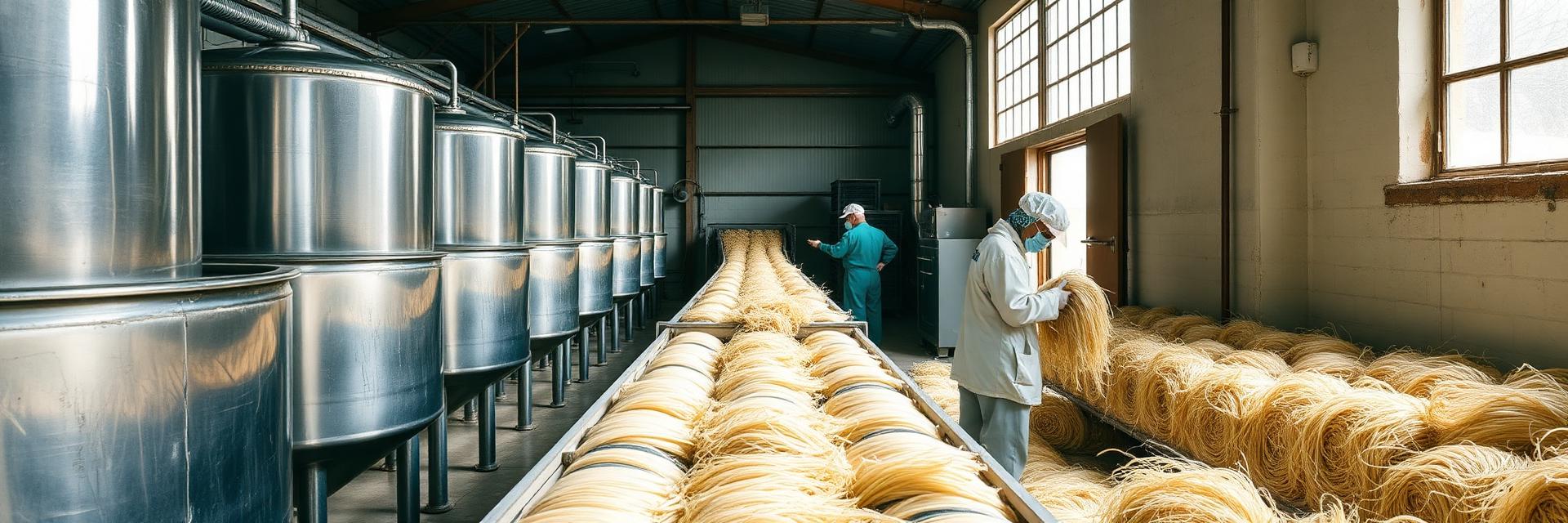
One yard, one weighbridge, two products instead of one.
Most small-scale pyrolysis fails on feedstock. Wet, mixed, unscreened material makes inconsistent char that no methodology will accept. Our fibre line hands the kiln dry, screened, single-species fines as a matter of routine, because that is what the compounder rejects.
The heat loop is the part that makes the economics work. Syngas from the reaction is burned in the same unit rather than flared, and the waste heat is ducted into the drying floor. That removes the argument for a gas burner at origin and takes cost out of a stage we were paying for anyway.
- What happens
- One yard, one weighbridge, one set of records. The biochar venture needs no separate collection round because the material is already there.
- New or existing
- Existing fibre chain
- What happens
- Bast fibre goes to the grower's textile buyer, hurd goes to our compound, and the dust, fines and short fibre are the fraction nobody has a use for.
- New or existing
- Existing fibre chain
- What happens
- Feedstock is dry, uniform and already screened, which is the single hardest input condition for small-scale pyrolysis and the reason most village kilns underperform.
- New or existing
- New for the JV
- What happens
- Oxygen-limited conversion in a continuous retort. Char out of the bottom, syngas burned in the same unit to sustain the reaction rather than flared.
- New or existing
- New for the JV
- What happens
- The waste heat that would leave the stack is ducted into the drying floor, cutting the drying stage cost and removing the case for any fossil burner at origin.
- New or existing
- New for the JV
- What happens
- Batch sampled for fixed carbon, hydrogen to organic carbon ratio, ash and contaminants. The grower's soil allocation is taken first; the balance is saleable.
- New or existing
- New for the JV
- What happens
- Soil amendment sold locally, and durable removal tonnes registered if and only if the MRV is in place. Neither line is counted twice.
- New or existing
- New for the JV
The loop, in one line
Residue in, bast fibre to the grower's textile buyer, hurd to our compound, fines to the kiln, char to soil or to a registry, and the process heat back into the drying floor that made the hurd usable in the first place. Nothing leaves the yard as waste.
Removal with the process emissions taken back off.
Char mass times fixed carbon times the permanence fraction, converted at 44 over 12. Then kiln fuel and handling are subtracted, and the recovered drying heat is credited only against the fossil burner it genuinely replaces. Drop the permanence fraction to sixty per cent and the number still stands up, which is the point of putting it on a slider.
Assumptions
Feedstock available to the kiln
3,700 tShare actually pyrolysed
70 per centPermanence fraction claimed
75 per centChar returned to growers for soil
35 per centSoil amendment price
£210/tDurable removal price
£118/t CO2Feedstock pyrolysed
Estimated2,590 t
A year, screened fines and short fibre
Biochar produced
Estimated777 t
272 t to grower soil, 505 t sold
Gross removal
Estimated1,667 t
CO2 locked in the char before deductions
Net removal
Estimated1,674 t
Less 109 t process, plus 116 t heat credit
Soil amendment revenue
Estimated£106,061
Sold locally, grower allocation excluded
Removal revenue
Estimated£197,565
Only if the MRV below is in place
Verification cost
Estimated-£43,531
£26 per tonne CO2, netted off
Net to the JV
Estimated£260,094
Split by the structure chosen below
The ratio, shown so it can be judged
At these settings the programme removes enough durable carbon to match the modelled cradle-to-gate footprint of 4,064 benches a year, against 412 kg CO2e per bench. Removal per tonne of feedstock is 0.45 t. We publish that ratio because a reader is entitled to weigh it. We do not subtract it from the bench footprint, and no headline figure anywhere on this platform is net of biochar.
Who owns the kiln, and who owns the carbon.
The second question is the one most schemes leave vague, and it is the one growers should ask first. Our default is the first structure: the cooperative owns the kiln and the carbon rights, financed against our offtake, and we buy removal tonnes at an agreed price rather than helping ourselves to them.
- Kiln owner
- Grower cooperative, financed against our offtake agreement
- Carbon rights
- Held by the cooperative. We buy removal tonnes at an agreed price and retire nothing on their behalf without written instruction.
- Char sales
- Cooperative sells locally; we take no cut of soil amendment revenue
- Grower profit share
- 80%
- Capital per site
- £92,000
- Strength
- Fastest to stand up, cleanest story, and the carbon asset sits with the community that produced the feedstock.
- Weakness
- We do not control operating discipline, and a badly run kiln produces char that fails characterisation and earns nothing.
- Kiln owner
- Shared entity, growers and Canopei
- Carbon rights
- Split with the profit share, registered once, with the split written into the registry account before the first batch.
- Char sales
- Sold through the JV, grower soil allocation taken out first at no charge
- Grower profit share
- 50%
- Capital per site
- £138,000
- Strength
- We can hold the operating standard that makes the char sellable, and the accounting is single-entity, which auditors prefer.
- Weakness
- Cross-border governance, real reporting duties, and buy-out mechanics that must be agreed up front rather than negotiated later.
A removal tonne is a measurement, not an intention.
The accounting basis is a durable-removal methodology of the Puro.earth type[1], with char quality thresholds from the European Biochar Certificate[2] and the treatment of soil carbon as long-lived taken from IPCC inventory guidance[3]. Two of the six requirements below cannot be met until a kiln is running, and they are marked accordingly.
- What it means here
- Only residue that would otherwise be burned or left to decay qualifies. Because the fibre line takes the structural fraction first, the kiln feed is by definition the fraction with no alternative use, which is the cleanest additionality argument available.
- Status
- Specified
- What it means here
- Fixed carbon, hydrogen to organic carbon ratio below 0.7, ash, and heavy metal and PAH limits, sampled per batch and retained. Without the H to Corg ratio there is no permanence claim to make.
- Status
- Specified
- What it means here
- Feedstock in, char out, moisture at both ends, tied to the same batch identifier the fibre chain already carries from field to deck.
- Status
- Specified
- What it means here
- Kiln fuel, handling, and transport of char to its application site are subtracted before any tonne is claimed. Recovered drying heat is credited only against the fossil burner it genuinely replaces.
- Status
- Specified
- What it means here
- A durable-removal methodology of the Puro.earth type, verified by a third party, with issuance on a public registry so a buyer can see the serial number rather than our spreadsheet.
- Status
- Not yet
- What it means here
- Where the char physically went, on whose land, at what rate. This is the line most schemes leave loose and the one a serious buyer checks first.
- Status
- Not yet
What we will not claim until a kiln is running.
There is no kiln. Every removal tonne on this page is a model output from a stated feedstock, char yield and permanence fraction, not a verified or issued credit.
We do not claim the bench is carbon neutral, and we do not net biochar removals against the bench footprint in any headline figure. The ratio is shown so it can be judged, not so it can be spent.
Removal tonnes cannot be sold twice. If a tonne is sold as a credit, it is not also counted inside our own footprint reduction, and the register on the ESG page states which side each tonne sits on.
Soil amendment yield and water-retention benefits are real in the literature and highly site-dependent. We report them as Estimated and we will not put a yield uplift percentage in a sales deck until our own partner trials produce one.
Open-air burning of the same residue is the counterfactual, and it is a genuine air quality harm today. That strengthens the case for the kiln and does not, by itself, entitle us to a carbon claim.
Where the feedstock comes from, partner by partner.
The kiln does not have a feedstock market. It has the fines from the same yards that make our fibre, which is why the carbon side cannot outgrow the bench side. Full carbon rights and MRV evidence per partner sit on the Africa chain page.
- To the kiln
- 1,344 t/yr
- Char
- 403 t/yr
- Net removal
- 869 t CO2/yr
- MRV documented
- 50%
- Carbon rights held by
- Jointly owned unit, split 50/50 at the registry account
- To the kiln
- 780 t/yr
- Char
- 234 t/yr
- Net removal
- 504 t CO2/yr
- MRV documented
- 0%
- Carbon rights held by
- Grower cooperative, financed against our offtake
- To the kiln
- 646 t/yr
- Char
- 194 t/yr
- Net removal
- 418 t CO2/yr
- MRV documented
- 25%
- Carbon rights held by
- Grower association, held on behalf of member farms
- To the kiln
- 504 t/yr
- Char
- 151 t/yr
- Net removal
- 326 t CO2/yr
- MRV documented
- 0%
- Carbon rights held by
- Operator companies, individually
- To the kiln
- 2,744 t/yr
- Char
- 823 t/yr
- Net removal
- 1,774 t CO2/yr
- MRV documented
- 25%
- Carbon rights held by
- Board and Canopei, jointly, per estate
Farmgate to delivered char, with the document that travels with it.
A removal claim is only as strong as the weakest record in this line. Each step states what is physically measured, what document leaves it, whether that document exists today, and what a gap does to the claim downstream.
1.Farmgate: residue leaves the field
Not yetOrigin, at the field edge · custodian: Grower
Measured here
Field identifier, harvest date, crop and estimated wet mass
Record that travels on
Field ticket carrying the identifier every later document quotes
Without a field identifier at the start, nothing downstream can prove the feedstock is residue rather than purpose grown biomass, and eligibility fails before any measurement matters.
2.Weighbridge in at the yard
Format agreedDecortication yard · custodian: Cooperative or operator
Measured here
Calibrated gross and tare mass, moisture at intake
Record that travels on
Weighbridge ticket linked to the field ticket
Mass is the multiplier on every removal tonne. An estimated intake mass caps the whole claim at Estimated permanently.
3.Separation into fibre, hurd and fines
Not yetDecortication yard · custodian: Cooperative or operator
Measured here
Mass balance across the three streams, so the fines fraction is a measured output and not a residual guess
Record that travels on
Daily separation log, three masses that must reconcile to intake
If fines are inferred by subtraction, the kiln feed mass inherits every error in the other two streams.
4.Kiln charge
Not yetPyrolysis unit, same yard · custodian: Joint venture
Measured here
Batch mass in, moisture, start and end temperature, residence time, kiln energy and fuel
Record that travels on
Batch sheet, one per charge, with the field identifiers it contains
No batch sheet means no batch, and a methodology will not issue against a shift average.
5.Char out and characterisation
Format agreedYard, then accredited laboratory · custodian: Joint venture, laboratory independent
Measured here
Char mass, fixed carbon, hydrogen to organic carbon ratio, ash, heavy metals and PAH
Record that travels on
Laboratory certificate bound to the batch sheet number
The H to Corg ratio is the permanence marker. Without it there is a quantity of black carbon and no durable removal.
6.Grower allocation taken
Format agreedYard · custodian: Grower
Measured here
Mass retained for own soil, before anything is offered for sale
Record that travels on
Allocation note, deducted from the saleable balance
Char taken for the grower's own land and also sold as a removal is the same tonne counted twice, which is the failure mode this step exists to prevent.
7.Delivery and application
Not yetBuyer field or local grower · custodian: Receiving party
Measured here
Delivered mass, destination reference, application date and rate
Record that travels on
Signed application record, closing the batch
An unapplied tonne is a stockpile, not a removal. Issuance without a closing record is the single most common audit finding in this sector.
8.Issuance and retirement
Not yetPublic registry · custodian: Rights holder under the JV structure
Measured here
Net removal tonnes after process emissions and the heat credit
Record that travels on
Registry serial range, and a retirement certificate when a tonne is spent
Tonnes claimed but never serialised cannot be audited by a buyer, and a tonne retired twice is fraud rather than error.
Privacy boundary
The chain records material, not people. A field identifier, a mass and a date are commercial facts about a consignment; a grower's name, plot boundary or household is not published on this platform and is not part of any registry submission.
Where a smallholder association aggregates many farms, the registry sees the association and the aggregate mass. Member level allocation is settled inside the association under its own rule, and we do not hold or publish that split.
Application records name a destination reference, not a person. A buyer verifying a batch gets the serial, the mass, the laboratory certificate and the date, and nothing that identifies an individual.
No sensor on a bench is part of this chain. Node telemetry and the custody record are separate systems with separate retention, and neither can be joined to the other from the public side.
Methodology sources, stated in full.
- [1]
Biochar methodology for durable carbon removal · Puro.earth
The accounting basis used here: durable removal by biochar, verified per batch and issued on a public registry, rather than avoidance offsets bought on a market.
Verified
- [2]
Guidelines for the production of biochar · European Biochar Certificate
Char quality thresholds referenced in the characterisation requirement, including the hydrogen to organic carbon ratio and contaminant limits.
Verified
- [3]
2019 Refinement to the 2006 IPCC Guidelines, biochar in managed soils · IPCC
That biochar carbon in soil is treated as long-lived in national inventory guidance, which is the basis for a permanence fraction rather than a full-carbon claim.
Verified